Art and Science Are the Same Because They Both Focus on the External Exploration of Images or Ideas
From the Existing Creative and Creative Processes to the Artistic Creative Process
The creative procedure is divers as a succession of thoughts and deportment leading to original and appropriate productions (Lubart, 2001; Lubart et al., 2015). The creative process may be described at two levels: a macro level, featuring the stages of the creative process, and a micro level, which explains the mechanisms underlying the creative process, e.g., divergent thinking or convergent thinking (Botella et al., 2016). Although the works carried out on micro-processes tend to agree on a set of mechanisms that can be involved in the creative process, piece of work focusing on macroprocesses accept not achieved consensus regarding the nature or the number of stages involved in the creative process. Table 1 shows some of the different models that tin can be institute in the scientific literature, with overlaps or divisions between some stages of the models. In this paper, nosotros treat micro-processes as contents of a more global, macro-level procedure, which make it possible to describe the construction of a work of art from the first (i.e., the wish to create) to the end (exhibiting that work). Moreover, the process can be examined in a psychological and private or in a socio-cultural perspective (Glǎveanu, 2010; Burnard, 2012). In the present study situated in the visual art field, nosotros volition consider the creative artistic procedure as an individual phenomenon.
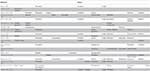
Table i. Synthesis of some examples of models of creative process.
Fine art is ofttimes considered to be an archetypal domain of creativity research (Schlewitt-Haynes et al., 2002; Stanko-Kaczmarek, 2012), complimented by research on scientific, musical, design-oriented, and literary creativity (Glaveanu et al., 2013). Even if some overlap can be observed betwixt unlike creative fields, each field has its ain specificities (Botella and Lubart, 2015). The purpose of this section is to merge some existing models of the creative process and creative procedure to examine what the creative artistic process could exist. Obviously, this section cannot be exhaustive simply offers a first consideration of the numerous important stages of the creative artistic process.
The procedure starts past an orientation, in which the individual identifies the problem that must exist solved (Osborn, 1953/1963), called as well a stage of problem option (Busse and Mansfield, 1980) or a sensitivity to problems (Guilford, 1956). Problem definition involves producing every bit many questions every bit possible. For Runco and Dow (1999), problem-finding refers to a process of "sensing gaps" (Torrance, 1962)—that is, detecting elements that are defective. In the same vein, Bruford (2015) proposed a stage of differentiation consisting of retaining information that leads to producing something different, involving interpretative and expressive musical differences. Additionally, Mumford et al. (1994) suggested making a distinction between discovering a trouble (i.eastward., rejecting problems that are untrue, incorrect, or incomplete; Getzels and Csikszentmihalyi, 1976; Arlin, 1986), posing the trouble (i.due east., finding a right formulation), and constructing a problem (i.e., describing the problem). In the artistic field, Fürst et al. (2012) proposed a model of art production that includes a goal of creation.
Then, at that place is preparation, the start stage described in the early macroprocess model by Wallas (1926). Carson (1999) explained that, in this stage, the individual defines the problem (or understands it; Treffinger, 1995) and gathers data in club to solve it. Based on a series of interviews with novelists, Doyle (1998) argued that the creative process begins with an incident, when an individual discovers an thought. In the creative process literature, Mace and Ward (2002) proposed a four-stage model based on interviews with professional artists. For them, the artistic process begins with the design of an artistic work. Hence, piece of work is initiated by a more-or-less vague idea or impression. Recently, based also on a series of interviews with professional person artists, Botella et al. (2013) identified six stages in the creative procedure in art, starting by an idea or a "vision" in which an prototype, a sight, a sound resonates with the artist.
Before the second main stage described by Wallas (1926), some authors added complementary stages later on preparation. Based on a previous review of the literature, Botella et al. (2011) propose a phase of concentration ("I am concentrating on the work I accept to exercise") in which it is possible to focus the creator's attention on those solutions deemed to be adequate, and to reject the other solutions (Carson, 1999). Osborn (1953/1963) added analysis, when the creator takes a stride back to identify the relations between ideas and the importance of each idea; and ideation, when the private develops alternative ideas. Busse and Mansfield (1980) indicated also a stage requiring making an try in order to solve the trouble.
And so, according to Wallas (1926) and many other authors, incubation occurs (Osborn, 1953/1963; Shaw, 1989, 1994; Runco, 1997; Runco and Dow, 1999; Botella et al., 2011). This is a time of confinement and relaxation, where thought associations accept identify at a subconscious level (Carson, 1999). Recently, Sadler-Smith (2016) reintegrated a 5th stage in the Wallas' model: intimation occurs between incubation and insight. Intimation is described as an "association-train" in a fringe conscious level, between witting and unconscious levels (p. 346). Cropley and Cropley (2012) revisited also Wallas's piece of work and split the phase of incubation into activation and generation. The process once once more becomes conscious in the stage of ideation, with the generation of further ideas, which are not necessarily judged or assessed. The individual and so experiences an illumination or insight (Eureka!) with the emergence of an idea, an prototype or a solution (Wallas, 1926; Carson, 1999). Boden (2004) noted that illumination or insight needs previous thought-processes.
Idea generation can take place in diverse means according to the dissimilar models. Busse and Mansfield (1980) described a stage in which the creator sets the constraints related to the solution of the trouble and, then, some other stage involving the transformation of these constraints or adaptation of the constraints that are not suitable. For Doyle (1998), there is some form of navigation between diverse knowledge domains, which makes information technology possible to assess the relevance of this idea. Based on Dewey (1934), Bruford (2015) proposed a selection phase in which the creator choses ane choice amidst several, requiring agency and control abilities. In the field of art, Mace and Ward (2002) named this step thought evolution in which the creative person structures, completes, and restructures the idea. Botella et al. (2013), through interviews with professional artists identified a stage of documentation and reflection during which artists gather more information almost the materials and technologies required in order to turn their vision into reality. The final stage described by Wallas (1926) is verification (Busse and Mansfield, 1980). New ideas are tested and verified, leading to the elaboration of a solution and to its production (Carson, 1999). More precisely, Osborn (1953/1963) proposed two distinct phases of synthesis, which consists of gathering ideas together and distinguishing relations between them.
Gruber (1989) argued that the four-stage model is incomplete. For Russ (1993), there lacks a phase of application, or deployment of the creative production. Treffinger (1995) added finer a stage of idea production, leading to action by planning. This work corresponds to the evolution and implementation of ideas through a search for solutions (evaluation, selection, and redefinition), and then the acceptance of this solution (promoting an idea, looking for its strengths and drawbacks). This terminal stage makes it possible to materialize the ideas that take been constitute and to solve the problem. In this vein, in the field of art, Mace and Ward (2002) described the realization of an idea, during which the artist transforms that thought into a concrete entity. Botella et al. (2011) also added stages of planning ("I am planning my piece of work"), and product ("I am producing/composing my ideas"). Results of observations in the art field suggested that the product stage is comprised, in fact, of two stages: a phase that consists of searching for ideas through the creative gesture (sketches, drafts, mock-ups), and and then a stage consisting of the realization of an idea that is already constructed (transposing an idea to a physical medium). The initial stage of "production" describes a similar activeness, but the underlying cognitive micro-processes are different. In the first case, the goal is to produce in order to formulate an thought whereas in the second case, it is to produce in gild to implement an thought that already exists. In a written report consisting of interviews of professional artists, Botella et al. (2013) confirmed the stages of first sketches to give a material form to the initial project, testing the forms and ideas that originated from reflection and preliminary work, and provisional objects, "drafts" and most-finished products. Revisiting Wallas' model, Cropley and Cropley (2012) mentioned a stage of advice, equally Bruford (2015) with musicians.
For Osborn (1953/1963), the concluding stage is evaluation (Runco and Dow, 1999; or assessment for Bruford, 2015), in which the individual assesses the chosen idea. For Mace and Ward (2002), the final footstep of the creative process, called finalization, brings the creative work to decision (or validation co-ordinate to Botella et al., 2011; Cropley and Cropley, 2012). The artist reassesses the production and may cull to finish, to elaborate, abandon, filibuster, store, or destroy information technology. If the artist believes the mission that was set has been accomplished, the creative person may cull to exhibit the production. Recently, professional artists suggested to add one more stage with serial, transforming a first object to many objects (Botella et al., 2013).
All these models were developed based on rational or empirical approaches. Original works and models from Poincaré and Wallas' were conceived based, respectively, on their own experience and pragmatic empirical observations. Patrick (1935, 1937) supported Wallas proposal by collecting empirical data in terms of observations and verbal reports of poets and artists who were invited to do a specific creative job. Nigh of the "phase models" are then based on this kind of rational or empirical analyses, with verbalizations, specifications, and clarifications of the processes past the participants themselves in the majority of cases. Therefore, these models maybe be considered every bit a specific approach to creativity, distinct from the psychometric, trouble finding or cerebral experimental approaches (Kozbelt et al., 2010). Recent studies on the four-stages model of Wallas confirmed again that researchers do non concur on the number of stages: Cropley and Cropley (2012) found vii stages whereas Sadler-Smith (2016) constitute five stages based on Wallas' volume.
Objectives
Models of the creative process and of the artistic procedure do non agree on the nature or on the number of steps involved in a creative artistic process (see Howard et al., 2008). This lack of a consensus could be explained by the fact that (a) the creative procedure is a circuitous phenomenon as described by Osborn (1953/1963) who believed that creation is set off by "stop-and-go" or "grab what yous can"-type processes; (b) models of a creative process are synthetic based on a specific artistic population and a specific creative domain, though these are described as if they were generic and could apply to all domains whether art, science, music, writing, or pattern. The process is nigh often described in full general terms, as if it should apply to all creative domains, whether it is art, science, music, writing, or design; (c) descriptions of the artistic process practise not always take into account the definition of inventiveness, in particular the contextually rich, situated nature that originality, and ceremoniousness may accept; and (d) the methodologies used were unlike [exist it a review of the literature (Busse and Mansfield, 1980; Botella et al., 2011), a series of interviews with novelists (Doyle, 1998), with professional artists (Mace and Ward, 2002; Botella et al., 2013), or an applied and consulting-based approach (Carson, 1999)].
The aim of the present written report is to question straight some stakeholders of artistic creativity, namely visual art students. However, it is perchance too ambitious to ask them to describe completely their creative process. We suggest that the lack of consensus in the previous studies could be due to the desire to capture all aspects of the creative procedure in the same study. And then, the students interviewed here depict only what constitutes, for them, the stages of their process of artistic creativity. We enquire them specifically to list the stages of their process in order to be equally exhaustive as possible. This qualitative written report makes it possible to identify what stages the students consider relevant in their mental representation of the visual artistic creative process, rather than relying on stages extracted from the scientific literature on creativity. With this report, we will not able to take a macro vision of the unabridged creative creative process simply we volition construct an inventory of the stages involved to moving-picture show this procedure.
Given the descriptive nature of the present research on the artistic creative process, the findings can be integrated in farther work as a part of the Creative process Report Diary (CRD, Botella et al., 2017). The CRD is a useful and relevant analytical tool to appraise the creative process in a natural context, when it occurs, allowing ecological validity. It is possible to realize diverse versions of the CRD depending on the context, the creative field, and any other considerations. The CRD has two parts: a role listing the stages of the artistic process (which volition be as exhaustive as possible based on the present report) and a part listing factors such equally cerebral, conative, emotional, and environmental ones that may come up into the creative procedure (for case, we could appraise team work; Peilloux and Botella, 2016). Finally, the CRD allows the creative process to exist modeled for individuals in situ during all the time needed for their creation. Thus, the purpose of CRD will be to detect the link and the transitions between the stages of the artistic artistic process and to examine which factors will exist involved at each stage. All the same, to practise that, nosotros need, in the nowadays study, to list as exhaustively as possible all the stages of the visual artistic creative process which will allow a specific CRD to exist created to notice the process in farther study.
Methods
Participants
The sample was composed of 28 students in the second year of a visual graphic arts schoolhouse. Seventeen students were female and 11 were male (hateful age = 20.9 years old, sd = 1.7, span = 19–24 years old). The rational for the choice of this sample was to interview participants with some artistic experience but to avoid a sample habituated to interviews with strongly formatted ideas. In previous research, when nosotros interviewed professional artists (Botella et al., 2013), we noticed some routines in the discourse. Some artists were familiar with interviews and they narrated a story, usually the story of an artwork merely sometimes the reports were distanced from their own story and therefore from their ain artistic process.
Interview Guide
The goal of the report was to construct a list of the stages of the process of visual artistic creativity. Given this, the interview guide was purposely kept short and open, and consisted of just two questions: (1) "how does your artistic process generally have place?" and (2) "how would you name the stages that y'all have merely mentioned?"
The interviewer'southward follow-up questions allowed the students to draw another stage of their artistic procedure. The main prompts consisted of reformulating the last sentence provided by the participant and asking "When you did […], what do you practice next?" or "Can you lot depict more precisely what you do when you lot finish […]?" It was very important to not induce ideas with our questions and then, nosotros just reformulated the words used by the visual fine art students themselves to assist them listing the stages of their artistic artistic process.
Interviews were semi-structured and lasted 10 min on average. Obviously, the interviews were too curt to capture all the complication of the artistic creative process with its "end-and-go" or "grab what yous tin" aspects (Osborn, 1953/1963). However, to brand an inventory of the stages it was enough. The added value of this written report is to focus the interview on the stages that visual art students themselves considered and how they named them.
Process
Ethics approval was non required co-ordinate to our institution'southward guidelines and national regulations. Later on the participants provided informed consent, the volunteer students were interviewed in their art school, during their grade on creativity. This state of affairs made it easier for them to recall the stages of their visual creative artistic process. Participants were led to a divide room to take part in a one-on-ane give-and-take with the interviewer. The interviewer (and so, the analyst) was the first author, with knowledge on the literature about creativity and creative process, who had already realized many interviews mainly with artists (Botella et al., 2013; Glaveanu et al., 2013). The prompts consisted of reformulating what participants said to assure that we did not induce the use of sure terms.
Results
Given our objective was to inventory the stages of the artistic artistic process, we analyzed the words employed during the interviews. The terms used by students were grouped in equivalence sets using Tropes software which presents references cited at least 3 times. The name retained for the category was the most cited term; others citations were used to describe the category. In the start office of the analysis, we focus on the stages of the process of visual artistic creativity that emerged spontaneously from the participants' discourse. Hence, nosotros volition bargain with the responses to the showtime question in the interview guide. In the second part, nosotros will examine the stages named past the students. Finally, we will confront these two analyses, in lodge to check whether the stages named by the participants exercise indeed represent to those referenced in the discourse. It is expected that the names volition be very similar for both analyses but this confrontation serves to cross-check the categorized sets of terms and their labels.
Identifying the Stages of the Process From the Students' Open Soapbox
Based on the students' responses to the first question in the interview guide, all the terms cited at least iii times were listed. It should be noted that the software can already group some terms co-ordinate to the context: for example, "impossible" and "not possible" are considered as similar. The software tin can besides place co-occurrences of combined terms, such as "practical fine art." Then, terms were grouped by the analyst according to the context in which they appeared (see Table ii). The context helped us to identify the terms concerning the artistic process. When terms seem to represent to the same thought, they were grouped together, such every bit "Sketchpad," "sketch," "drawing," and "writing." We conducted an dominant hierarchical classification, grouping 2 by ii the closest words. The number of clusters was not decided in advance and the grouping was stopped when we considered that another aggregation was non relevant. Terms that did not refer to the creative procedure were non retained ("twelvemonth," "fine art," "phase," "have an inclination toward," "social environment," etc.).
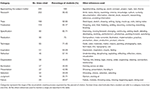
Table ii. Categories of references used in the students' soapbox.
In Table 2, the number of times that a category was cited and how many students referred to this category are indicated considering the same pupil could mention the same category several times. One stage consists of approaching the discipline matter, taking possession of it, gaining knowledge well-nigh the subject field-related words used (S14: "And then, you go there, you throw yourself"). Reflection refers to the students' efforts for deciphering and agreement the topic. This stage may imply visualized images (S1: "I think, I get things straight for a week"). The stage of research involves the student going to the library in order to collect references to artists and to prior work (S4: "I am looking for references to see what has been done. There is a fourth dimension of documentation"). So the student constructs a noesis base of operations of works which have already been produced, before distancing themselves from these works. Inspiration is based on ane's impression and experience of a given subject field affair (S24: "it's really how I feel it and I know I'll be able to go along on it"). Although the term illumination was not used, we can note the presence of this stage in students' reports of "an thought suddenly appearing" or "coming across an thought by blow" (S6: "Information technology's not totally witting. It comes like this. Ideas come alone. Nosotros feel it. And afterward that, we attempt from that to bring this idea in a frame that could be advisable"). Trials correspond to producing notebooks containing sketches. Students record their sketches, and brand attempts earlier they can observe an idea (S27: "I attempt to explore equally many things as possible"). Organization consists of students ordering, guiding, and organizing their arroyo by mixing existing ideas and combining them together (S25: "In that location is an order to be divers"). The pupil will accept to select an idea out of all those produced (S25: "I will select what is best"). A work involves inevitably 1 or more techniques (S18: "Whether computer, photoshop or cartoon, rush. Actually, exploit everything I know every bit technical before y'all get to a final thingy"). Depending on individual preferences and on the constraints of the situation, the student will choose to use a particular technique. The product of the creative process is made concrete during the stage of realization (S9: "I become directly to the realization with the materials. I take the painting and I practise it directly to clean"). The stage of specification indicates that the educatee improves, specifies and adds the finishing touches to the work (S15: "I am improving what I have already fatigued. Above all, I simplify. Considering I tend to put too much"). Finalization refers to the stage in which the work is completed, finished, and voluntarily stopped (S28: "I am very meticulous and I spend a lot of fourth dimension on the finish"). The stage of judgment corresponds to assessing the work that has been produced (S27: "Mostly, I have to finish in accelerate then I tin await at it for a long time and so come across if something is missing or not. Considering sometimes, I have the impression that it is not finished at all and, past dint of looking at it, finally I realize that it misses nix or that information technology misses things precisely"). The presentation is the moment when students present their work to their teachers (S20: "Information technology's when I show to the teachers"). The stage of failure indicates that the educatee has abandoned something, exist information technology the piece of work or an idea. In the latter case, the educatee throws abroad one idea and starts something new, or starts again based on an existing work (S3: "If information technology'south not expert, I do not leave, I start again. It happens to me oft when I'1000 washed and it's ugly, that I know it's not good, I don't intendance, I spend another 8 hours, x hours to rework some other volume. In full general, when I resume it's all the same the same theme, but information technology'southward not the aforementioned idea").
Identifying the Stages of the Process Named by Students
This analysis focused on the second question in the interview guide, i.e., how the students named the stages in their visual artistic creative process. Terms were grouped in Table 3. From in that location, we were able to identify 16 stages in the process of visual artistic inventiveness.
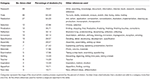
Tabular array 3. Categories used in naming the stages of the artistic process.
Immersion refers to assimilating the work to exist washed; it involves listening to the instructions given by the teacher, defining the words in the topic, and entering into the project. Reflection relates to a course of brainstorming where the student attempts to sympathize, to decipher the topic and to reflect upon it. Enquiry may focus on artists, documents, books, the Net, and aims for the students to construct a cognition base for themselves. Inspiration seems to exist related to intuition and instinct. Apparition refers to ideas being institute and actualization of their own accord. Trials designate all the try-outs, notes, sketches, notes, and testing fabricated by the students. Associates refers both to attempting a new arroyo and to the unlike ideas that sally from assembling ideas together. The stage of new ideas includes different ideas which emerge. The phase of selection involves choosing an thought. Materials were also mentioned in terms of photography and volume. The stage of realization refers to action, limerick, concretization, production, and to the transfer of an idea to a medium. The stage of specification tin be viewed as increasing the depth of analysis, developing the work, and correcting it. Finalization is the completion of the work. The stage of exam indicates taking a step back from the work, formulating an analysis of the work, and questioning ane's ain work. Presentation refers to the fact that students must justify, explain, and nowadays their work. The fact that students let the work settle, digest and exhale may refer to the concepts of breaks and incubation. Finally, the instructor was also cited as a office of the stages of the process of artistic creativity when students enquire for assist because they are stuck or when they need reference.
Confronting the 2 Analyses and Identifying the Stages in the Process of Visual Artistic Creativity
This confrontation allowed us to verify that the students had indeed described all the stages in their creative procedure, thus validating the number and nature of steps involved in the process to integrate these in the CRD (run across Table 4). Fourteen stages appear both in the gratuitous soapbox and the stages named past the students, one phase was mentioned only in the discourse, and two stages were mentioned when naming the stages of the process. In the end, 17 different stages were retained. But the stage referring to instructor was not retained because the teacher corresponds more to a social back up than a stage of the process. Additionally, the teacher can be partially included in the phase of research as a source of knowledge.
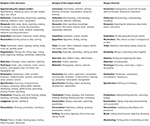
Table 4. Confrontation between the ii analyses.
In the phase of immersion, the goal is to apprehend the topic at paw and to listen to the instructions given by the teacher. Some students may sometimes feel the need to define the words and concepts present in the topic (S1: "What I practice personally, I take the words and I take a few days or fifty-fifty a week depending on the time of the project to go things straight, retrieve about it because sometimes in that location are topics that are very vague like that and we sympathise not at all. And and so it gets more and more than precise."). Such an arroyo allows them to "soak up" the topic and jump into the fray and starting time themselves off (S18: "The matter is, I often tend to get into an thought. When yous requite me a subject field or what. I guess correct now the affair and what I could do with it."). Reflection makes information technology possible to empathize what should be done, and to decipher the instructor'due south requirements. Mental work may sometimes begin with visualizing an image. This image may guide the student throughout the process (S20: "Me, I cannot start looking for a discussion if I do not visualize the concluding "what." Fifty-fifty if I will redo subsequently…"). During the stage of research the students acquire to search for artists, references, documents, and work already produced about the topic that they are apprehending. A solid knowledge base and a culture regarding prior work might help create new and original ideas (S15: "The teachers give u.s.a. research. Because when we come here, nosotros practise non necessarily take a culture in terms of graphics, anyhow. They give us references to go run across. This is considering, often, it is sometimes references of choreographers and it goes a little beyond the field of visual arts and graphics. And suddenly, it allows to compare universes. And then we meliorate what we do."). Inspiration occurs when an thought emerges slowly and gradually. According to the students, it is based on instinct, impressions, and feelings (S14: "Sometimes you feel that yous have a lot of information and from that, you can outset to catch something"). Although the word illumination was never mentioned, the literature places a stiff accent on this stage. It is translated in the interviews as "apparition," "coming across an idea," and "hey, there's an idea!," where the idea sometimes comes from an unknown place (S5: "Sometimes it comes alone."; S21: "I did not look. Information technology cruel on me in fact. And and so afterward, you accept to bounce dorsum."). The use of notebooks gather the students' trials, their sketches and their notes. They allow the students to try out and test an paradigm. More importantly, the teachers examine the notebooks to follow the evolution of the students' work. Notebooks show students' train of idea, how they achieved a item piece of work (S2: "These ideas, I always put them in my notebook to show them to the teacher."). Assemblies of ideas are the issue of logical connections that the pupil establishes between several existing ideas. Thus, it corresponds to the direction which the student wishes to give to the product and future piece of work (S3: "I try to mix everything together"). The phase of ideation was not mentioned in the discourse. Information technology was only mentioned when students were naming the stages. Selection refers to classifying and sorting ideas. The goal here is to choose which ideas can exist exploited, and which, on the other hand, should be gear up aside (S24: "It'southward difficult to choose, on which runway to become"). Technique is a very important aspect for aspiring artists. They must comply with codes, rules, discover a typography, a mode of their ain. Although this stage was rarely named as such by the students, it is very nowadays in their soapbox (S27: "I put in some technique. For instance, I had been taught a little virtually the technique of collage, I had exploited this thing after because I liked information technology. I tried to misconstrue information technology from school in my own way."). Realization refers to translating an idea into an image. Information technology is at this point that the composition and production of a material work accept shape (S18: "I effort to realize information technology at best"). The stage of specification reveals the improvements, the added details, the changes, and corrections made to the work underway. At this point, students add details that they had not necessarily planned initially (S23: "When I accept something that I like, I dig information technology even more than to see if I can exploit it"). Finalization refers to the bespeak at which the student decides that the piece of work is done. The work is complete, or nearly at the point of completion (S17: "It'southward never finished. For renderings, there is a fixed date and there it is finished. But just for a class. But in general, we always accept stuff to add together, photos to resume, stuff to put dorsum. Generally, we practise information technology if nosotros have a jury at the end of the year. And here, we try to finalize the project of the beginning of the year."). The term judgment was non explicitly mentioned either. However, information technology tin exist constitute in the terms of taking a step back, questioning ane's work, observing it with slap-up attention, and thus assessing it (S3: "I look at [my work]. I think instead of teachers. If I was a instructor, if I wait at, if there is something wrong, if there is a stain, if I encounter that in that location is something wrong, if information technology is not skilful, well cutting, I'll start all over again."). Although this phase was not direct mentioned in the students' discourse, the stage of the suspension also seems to be. Its goal is to let the ideas rest, digest, settle and "exhale." The soapbox suggests likewise the presence of trial and mistake. Because the word "failure" seems a little strong, we retain the term of "abandoning," whose connotations are less negative (S3: "Sometimes I change my idea and sometimes, when I piece of work, it'southward not possible like that").
Discussion
The goals of this study were to determine the nature and number of stages present in the creative visual creative process in lodge to build a specific CRD. Twenty-eight fine art students were asked to describe their process of visual artistic creativity and to name its stages. By comparison the discourse of these art students and the names they gave to the various stages of their piece of work, we identified 17 stages.
Immersion is nowadays in several existing models. It corresponds to preparation in Wallas' (1926) model (see Table v for a synthesis). Wallas views preparation as a preliminary assay which makes it possible to define and set the problem. The aforementioned idea is nowadays in Carson's (1999) consulting-centric model and in the work on the artistic procedure of actors (Blunt, 1966; Nemiro, 1997, 1999). Osborn (1953/1963) speaks instead of orientation, in which the individual identifies the trouble that is to be solved. Shaw (1989, 1994) proposes also the term "immersion." Reflection is typically included in grooming. Osborn proposes a stage when the private takes a step back to examine the connections that exist between different ideas. More recently, this stage of reflection was identified in interviews with professional artists (Botella et al., 2013). The phase of research is required by the schoolhouse of art (S8: "We have a lot of instructions from the teachers who assistance us. We must become through inquiry."). Research is besides mostly included in preparation. Information technology should exist noted that in Treffinger's model (Treffinger, 1995), preparation is called agreement. The goal hither is for the individual to search for data regarding the problem at manus. Also, Runco (1997) mentions a phase of information. Hither, the research stage could help visual art students to differentiate their own work from previous ones (Bruford, 2015). In the interviews with professional artists (Botella et al., 2013), this search phase was coupled with reflection, as a search for ways (i.e., cloth or technological) to transform the initial idea into a existent production.
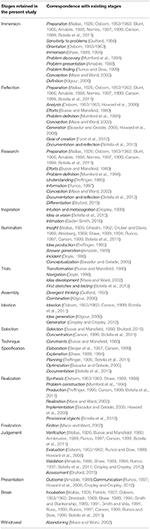
Table 5. Correspondence between the stages retained in the nowadays study and the existing stages in research field.
Inspiration corresponds to intuition and metacognition (Cropley, 1999). Amongst other things, it allows us to identify which approach will be more than efficient than another. Policastro (1995) defines intuition as an implicit course of information processing, which is intended to anticipate and guide creative research. According to her, intuition may allow an unconscious shift from incubation to illumination. Notwithstanding, intuition was never considered a stage in the creative procedure or in the artistic process. Therefore, it is a stage that is specific to the current study. As described by the students, the inspiration stage is close to the stage on intimation added between incubation and insight (Sadler-Smith, 2016). It is surprising and interesting that visual art students consider inspiration as a stage of their creative process. So, a replication of this written report volition be necessary to confirm if it is really a stage or if it is a factor involved in the artistic process. The give-and-take "illumination" was not mentioned by the students as such. Numerous authors accept previously shown that the illumination stage was seldom mentioned past students in art. Doyle (1998) has described illumination every bit an accident, where the solution emerges in a sudden and unexpected way (Wallas, 1926). Hence, the description that the students fabricated of this phase might be termed illumination: the idea comes or appears in an unexpected manner. Other authors believe that this experience of illumination would, in most cases, exist more than gradual than sudden (Ghiselin, 1952; Gruber and Davis, 1988; Weisberg, 1988). Although it is possible that illumination is not a part of all creative processes, or that the creators might non always be witting of information technology, the stage of illumination remains a key stage in the artistic process, considering information technology is at this stage that the idea takes shape.
The trials, tests, and fiddling fabricated by students may correspond to the stage of idea development in Mace and Ward's model (Mace and Ward, 2002). In their description of the artistic process, Mace and Ward argue that, during the development of an idea, the artist volition construction, consummate, and restructure the idea. Authors indicate that this trial stage will allow artists to course a more precise idea of the initial project for themselves. This stage is worked in Fine art school with sketchpads.
Assembly corresponds to the microprocess of divergent thinking, in which ideas are assembled and mixed together. In contrast, convergent thinking makes information technology possible to focus on a unmarried idea (Guilford, 1950). This mode of thinking allows individuals to find the 1 and but solution to a problem. The generation of ideas that have not yet been checked and assessed corresponds to ideation (Carson, 1999). Osborn (1953/1963) mentions a phase of synthesis, which consists of putting ideas together and distinguishing relations between them.
Pick refers to concentration (Carson, 1999). Concentration makes information technology possible to focus the attending of the individual on those solutions deemed to be adequate, and to turn down other solutions. No model emphasizes the phase of choosing a technique. Even so, the artist must place the technique that volition allow them to brand the thought materialize in the best possible manner. During the interviews with professional artists, technical issues were included in the stage of documentation (Botella et al., 2013). Nevertheless, in the present study, because 71.43% of the students mentioned this phase in their soapbox and 17.86% named information technology direct, we decided to consider "technique" equally a specific stage of the visual artistic artistic process. In further studies, information technology volition be interesting to explore if this stage is specific to visual arts or if it is a more common stage concerning other creative domains.
Specification might correspond to elaboration. Berger et al. (1957) defined elaboration as the private's ability to provide detail to the ideas produced. This stage may as well tie in with creative caption, whose goal is for the artist to explain the ideas (Shaw, 1989, 1994).
Realization refers to the creative production (Treffinger, 1995) or to creative synthesis (Shaw, 1989, 1994). The goal here is to make the idea concrete. "Technique" is generally included in this stage. Still, it seems that production points to the act of creating and to the gestures involved rather than to the cognitive or emotional pick of a technique. Mace and Ward (2002) speak also of realization, i.eastward., the transformation of an thought into a "physical entity." They note that for some physical arts and for a wide diverseness of artistic media it is necessary to have a detailed idea of what the artist is going to exercise. Hence, some decisions—such as, for example, those related to the choice of a technique—should be predictable.
Finalization corresponds, at least in part, to the finition phase in Mace and Ward (2002). The authors argue that finalization implies that the individual has decided that his/her piece of work is finished. If the artist considers the piece of work to be successful and satisfactory and they may choose to exhibit information technology. In that example, the stage of finalization also includes hanging upward or exhibiting the piece of work.
The stage of judgement of the creative production is very frequently named in models of the creative procedure. In particular, Wallas (1926) writes near verification, where the private assesses the idea that has emerged. At this phase, ane must take a step back from i's work and assess information technology. Verification may be of two kinds: "internal" verification, i.e., a comparing between the idea that has been produced and the idea formed during illumination or "internal" verification, which consists of anticipating the reactions of the audience (Armbruster, 1989). According to Busse and Mansfield (1980), verification may accept place earlier during the process, every bit the individual start verifies the ideas and then elaborates a solution. Other authors have argued that judgment occurs at a later stage. For example, Osborn (1953/1963) considers that evaluation is the moment when the individual evaluates the chosen idea. When describing the artistic process, Osborn (1953/1963) mentions the stage of analysis, in which the individual takes a step back to examine the connections that class between ideas and their importance. In contrast, Shaw (1989, 1994) addresses the concept of validation, thus emphasizing the importance of this stage. According to him, personal validation consists of appreciating ane'due south own work and in using the experience acquired over the course of this process to generate a new creative process. In addition to personal validation, at that place exists a collective level of validation. The latter deals with the evaluation of a creative product by peers, by an audience or by a critic. Commonage validation can only lead to a new procedure if at that place is acceptance of the evaluation that has been formulated. If the production is validated, it can then be followed by a serial in which the idea is extended to several works (Botella et al., 2013).
The stage of presentation is not typically described as such in models of the creative process or of the artistic process; its goal is to nowadays the piece of work to teachers. In the case of professional artists, this would refer more to the auction of a work. Yet, recent models included a communication phase (Runco, 1997; Howard et al., 2008; Cropley and Cropley, 2012).
The term "break" which has emerged in the stages named past students might correspond to incubation. As we have seen, this stage is very hard to assess and to take into business relationship (Botella et al., 2011), fifty-fifty though it is essential (Patrick, 1937; Dreistadt, 1969; Smith and Blankenship, 1989, 1991; Smith and Vela, 1991), especially to the expression of artistic creativity (Russ, 1993). The words used by the students highlight some unconscious associations. Indeed, they talk about letting their ideas remainder, letting them digest and decant. Incubation is always difficult to evaluate, because it relies in most cases on unconscious piece of work. Finally, although the stage of withdrawal is a discipline of inquiry, it is non included in most models of the creative process. Only Mace and Ward (2002) have into business relationship a clear possibility of abandoning the process at whatever time. Even if the process is brutally interrupted, the artist develops continuously new knowledge. This knowledge is the result of a perpetual, dynamic interaction with artistic practice. Artists extend and refine their repertoire of skills, techniques, and cognition. Likewise they acuminate their artistic interests and personality. New ideas can emerge in this piece of work, to be reused later.
Conclusion
Although this written report was limited by the interview method—and thus focused on students' implicit theories of their ain creative process—information technology immune us to place multiple stages in the process of visual creative creativity. Considering of the implicit theories and the number of models suggesting a linear sequence of stages, sometimes with some loops or cycles possible, it seems too ambitious to understand the sequence of the stages from interviews. The present study invites us to rethink what composes an artistic artistic process. Even if we already accept a long list of models, none is consummate and satisfactory. Information technology is possible that we may demand to construct and maintain a list of all the stages of the artistic process which tin can then be adjusted to each domain, given that the creative process may vary depending upon the area in question (Baer, 1998, 2010; Botella and Lubart, 2015). Given this uncertainty, connected research into the creative process is indicated. For now, the present list of stages of the visual artistic creative procedure could assist teachers in their coursework. During the interviews, students indicated that the stages of inquiry and the use of the diary notebook were required by their art school. This appears equally a limitation of the present study. We are non sure if fine art students described the prescriptive stages in their Art school or their real stages of creation. The question was oriented how their creative procedure generally takes identify merely because they are art students and they were interviewed in their fine art school, some prescriptive stages appears in their discourse. Withal, during the interviews, some students had specified if the stage is prescriptive and we indicated this point throughout this paper. With the updated list, teachers could suggest other exercises to guide art students for all the stages. Moreover, exterior an educational context, the demand for consultancy to stimulate business creativity is increasing (see Berman and Korsten, 2010), and the electric current inquiry may too provide a helpful template for the effective management of creative processes in this area of industrial innovation. However, nosotros have to exist careful about the use of such a list. By conceptualizing the creative process, are nosotros actually at risk of creating a "compatible" prescriptive model of how to be creative? We tin hypothesize that some creative process are more adapted to some artistic individuals but it would be counterproductive to try to force all individuals to appoint in the aforementioned process. The artistic process varies across fields (Botella and Lubart, 2015) and probably besides across culture, creators' personalities, and tasks.
These stages and more precisely their sequence should be validated in the field, by observing students as they conduct out creative piece of work—notably to determine the exact succession of the stages—using a tool similar the CRD. Moreover, it volition be interesting to observe the collaborative creative process also equally to situate the procedure in a more global socio-cultural arroyo. Every bit nosotros saw in the introduction, the creative process can be described using micro-level or macro-level approaches and more globally takes place in a particular socio-cultural context. These approaches could be used directly during observations of the creative process and associated with cerebral, conative, emotional, and ecology factors involved in the process.
Ideals Statement
All subjects gave written informed consent in accord with the Declaration of Helsinki.
Author Contributions
MB methodology, interviews, analyses, and writing; FZ methodology and writing; and TL methodology and writing.
Conflict of Interest Statement
The authors declare that the research was conducted in the absence of whatever commercial or fiscal relationships that could be construed every bit a potential conflict of interest.
References
Amabile, T. Thousand. (1988). A model of creativity and innovation in organizations. Res. Organ. Behav. 10, 123–167.
Google Scholar
Amabile, T. M. (1996). Inventiveness in Context. Boulder, CO: Westview Press.
Google Scholar
Arlin, P. G. (1986). "Problem finding and young adult noesis," in Developed Cognitive Development: Methods and Models, eds R. A. Mines and K. S Kitchener (New York, NY: Praeger), 22–32.
Google Scholar
Armbruster, B. B. (1989). "Metacognition in creativity," in Handbook of Creativity, eds E. P. Torrance, J. A. Glover, R. R. Ronning, and C. R Reynolds (New York, NY: Plenum), 177–182. doi: x.1007/978-i-4757-5356-1_10
CrossRef Full Text | Google Scholar
Baer, J. (2010). "Is creativity domain specific?," in The Cambridge Handbook of Inventiveness, eds J. C. Kaufman and R. J Sternberg (Cambridge: Cambridge University Press), 321–341. doi: 10.1017/CBO9780511763205.021
CrossRef Full Text | Google Scholar
Basadur, M., and Gelade, Grand. A. (2005). Modelling applied creativity as a cognitive procedure: theoretical foundations. Kor. J. Think. Prob. Solving 15, 13–41.
Google Scholar
Berger, R. M., Guilford, J. P., and Christensen, P. R. (1957). A factor-analytic study of planning abilities. Psychol. Monogr. 71, 1–29. doi: 10.1037/h0093704
CrossRef Full Text | Google Scholar
Berman, S., and Korsten, P. (2010). Capitalizing on Complexity: Insights from the Global Primary Executive Officer Written report. Somers, NY: IBM.
Google Scholar
Blunt, J. (1966). The Composite Art of Acting. New York, NY: Macmillan.
Google Scholar
Botella, M., Glaveanu, 5. P., Zenasni, F., Storme, Thou., Myszkowski, North., Wolff, Thousand., et al. (2013). How artists create: artistic process and multivariate factors. Acquire. Individ. Diff. 26, 161–170. doi: 10.1016/j.lindif.2013.02.008
CrossRef Full Text | Google Scholar
Botella, K., and Lubart, T. (2015). "Creative processes: fine art, design and science," in Multidisciplinary Contributions to the Science of Artistic Thinking, eds G. E. Corazza and S Agnoli (Singapour: Springer), 53–65.
Google Scholar
Botella, Chiliad., Nelson, J., and Zenasni, F. (2016). "Les macro et micro processus créatifs [The macro and micro creative processes]," in Créativité et apprentissage [Creativity and learning], ed I Capron-Puozzo (Louvain-la-Neuve: De Boeck), 33–46.
Google Scholar
Botella, Grand., Nelson, J., and Zenasni, F. (2017). It is time to find the creative process: how to use a artistic procedure Study Diary (CRD). J. Creat. Behav. doi: x.1002/jocb.172
CrossRef Full Text | Google Scholar
Botella, Grand., Zenasni, F., and Lubart, T. I. (2011). A dynamic and ecological arroyo to the artistic creative procedure in arts students: an empirical contribution. Empir. Stud. Arts 29, 17–38. doi: ten.2190/EM.29.one.b
CrossRef Full Text | Google Scholar
Bruford, W. (2015). Making it Piece of work: Creative Music Performance and the Western Kit Drummer, Unpublished dissertation, University of Surrey.
Google Scholar
Burnard, P. (2012). Musical Creativities in Do. Oxford: Oxford University Press. doi: 10.1093/acprof:oso/9780199583942.001.0001
CrossRef Full Text | Google Scholar
Busse, T. V., and Mansfield, R. S. (1980). Theories of the creative process: a review and a perspective. J. Creat. Behav. xiv, 91–132. doi: 10.1002/j.2162-6057.1980.tb00232.ten
CrossRef Total Text | Google Scholar
Carson, D. Thou. (1999). "Counseling," in Encyclopedia of Creativity, Vol. 1, eds M. A. Runco and S. R Pritzker (New York, NY: Academic Press), 395–402.
Google Scholar
Cropley, A. J. (1999). "Definitions of creativity," in Encyclopedia of Creativity, Vol. 1, eds One thousand. A. Runco and Southward. R Pritzker (New York, NY: Academic Press), 511–524.
Google Scholar
Cropley, D. H., and Cropley, A. J. (2012). A psychological taxonomy of organizational innovation: resolving the paradoxes. Creat. Res. J. 24, 29–twoscore. doi: 10.1080/10400419.2012.649234
CrossRef Full Text | Google Scholar
Dewey, J. (1934). Art as Feel. New York, NY: Penguin Books.
Google Scholar
Doyle, C. L. (1998). The writer tells: the artistic process in the writing of literacy fiction. Creat. Res. J. 11, 29–37. doi: 10.1207/s15326934crj1101_4
CrossRef Full Text | Google Scholar
Dreistadt, R. (1969). The use of analogies and incubation in obtaining insights in artistic problem solving. J. Psychol. 71, 159–175. doi: 10.1080/00223980.1969.10543082
CrossRef Full Text | Google Scholar
Fürst, G., Ghisletta, P., and Lubart, T. (2012). The creative process in visual art: a longitudinal multivariate study. Creat. Res. J. 24, 283–295. doi: ten.1080/10400419.2012.729999
CrossRef Full Text | Google Scholar
Getzels, J. Due west., and Csikszentmihalyi, Grand. (1976). "Concern for discovery in the creative process," in The Creativity Question, eds A. Rothenberg and C. R Hausman (Durham, NC: Duke University Printing), 161–165.
Google Scholar
Ghiselin, B. (1952). The Creative Procedure. Berkeley, CA: University of California Press.
Google Scholar
Glǎveanu, V. P. (2010). Paradigms in the written report of inventiveness: introducing the perspective of cultural psychology. New Ideas Psychol. 28, 79–93. doi: 10.1016/j.newideapsych.2009.07.007
CrossRef Full Text | Google Scholar
Glaveanu, 5. P., Lubart, T., Bonnardel, Northward., Botella, M., De Biasi, P.-Yard., De Sainte Catherine, M., et al. (2013). Creativity equally action: findings from 5 creative domains. Front. Educ. Psychol. 4:176. doi: x.3389/fpsyg.2013.00176
PubMed Abstract | CrossRef Full Text | Google Scholar
Gruber, H. Eastward. (1989). "The evolving systems approach to artistic work," in Artistic People at Work: Twelve Cognitive Case Studies, eds D. B. Wallace and H. E Gruber (New York, NY: Oxford Academy Press), 3–24.
Google Scholar
Gruber, H. E., and Davis, South. N. (1988). "Inching our way upwardly Mountain Olympus: the evolving systems approach to creative thinking," in The Nature of Creativity, ed R. J Sternberg (New York, NY: Cambridge University Press), 243–270.
Google Scholar
Howard, T. J., Culley, South. J., and Dekoninck, E. (2008). Describing the artistic pattern procedure past the integration of technology design and cognitive psychology literature. Des. Stud. 29, 160–180. doi: 10.1016/j.destud.2008.01.001
CrossRef Total Text | Google Scholar
Kilgour, Grand. (2006). Improving the creative process: analysis of the effects of divergent thinking techniques and domain specific knowledge on creativity. Int. J. Business Soc. seven, 79–107.
Google Scholar
Kozbelt, A., Beghetto, R. A., and Runco, M. A. (2010). "Theories of creativity," in The Cambridge Handbook of Creativity, Vol. 2, eds J. C. Kaufman and R. J Sternberg (New York, NY: Cambridge Academy Printing), 20–47.
Google Scholar
Lubart, T. I. (2001). Models of the artistic procedure: past, present and time to come. Creat. Res. J. 13, 295–308.
Google Scholar
Lubart, T. I., Mouchiroud, C., Tordjman, Southward., and Zenasni, F. (2015). Psychologie de la Créativité (Deuxième Edition) [Psychology of Inventiveness]. Paris: Armand Colin.
Google Scholar
Mace, M.-A., and Ward, T. (2002). Modeling the artistic process: a grounded theory analysis of creativity in the domain of art making. Creat. Res. J. xiv, 179–192. doi: 10.1207/S15326934CRJ1402_5
CrossRef Full Text | Google Scholar
Mumford, 1000. D., Reiter-Palmon, R., and Redmond, Grand. R. (1994). "Problem construction and knowledge: applying problem representations in ill-defined domains," in Problem Finding, Trouble Solving, and Creativity, ed M. A Runco (Norwood, NJ: Ablex), 3–39.
Google Scholar
Nemiro, J. (1997). Interpretative artists: a qualitative exploration of creative process of actors. Creat. Res. J. 10, 229–239.
Google Scholar
Nemiro, J. (1999). "Acting," in Encyclopaedia of Inventiveness, Vol. 1, eds 1000. A. Runco and S. R Pritzker (New York, NY: Academic Press), 1–8.
Google Scholar
Osborn, A. F (1953/1963). Practical Imagination, 3rd Edn . New York, NY: Scribners.
Google Scholar
Patrick, C. (1935). Creative thought in poets. Arch. Psychol. 178, 1–74.
Google Scholar
Peilloux, A., and Botella, M. (2016). Ecological and dynamical study of the creative procedure and affects of scientific students working in groups. Creat. Res. J. 28, 165–170. doi: 10.1080/10400419.2016.1162549
CrossRef Total Text | Google Scholar
Runco, M. A. (1997). The Creativity Research Handbook. Cresskill, NJ: Hampton Press.
Google Scholar
Runco, M. A., and Dow, G. (1999). "Problem finding," in Encyclopedia of Creativity, Vol. 2, eds Thousand. A. Runco and S. R Pritzker (New York, NY: Academic Press), 433–435.
Google Scholar
Russ, Southward. Westward. (1993). Affect and Creativity: The Role of Touch on and Play in the Creative Process. Hillsdale, NJ: Lawrence Erlbaum Associates Inc.
Google Scholar
Sadler-Smith, Due east. (2016). Wallas' four-stage model of the artistic procedure : more than meets the centre ? Creat. Res. J. 27, 342–352. doi: x.1080/10400419.2015.1087277
CrossRef Full Text | Google Scholar
Schlewitt-Haynes, 50. D., Earthman, Thou. S., and Burns, B. (2002). Seeing the globe differently: an analysis of descriptions of visual experiences provided by visual artists and nonartists. Creat. Res. J. 14, 361–372. doi: 10.1207/S15326934CRJ1434_7
CrossRef Full Text | Google Scholar
Shaw, M. P. (1989). The eureka process: a structure for the creative feel in scientific discipline and engineering. Creat. Res. J. 2, 286–298. doi: 10.1080/10400418909534325
CrossRef Full Text | Google Scholar
Shaw, M. P. (1994). "Melancholia components of scientific creativity," in Creativity and Affect, eds Thousand. P. Shaw and M. A Runco (Westport: Ablex Publishing), iii–43.
Google Scholar
Stanko-Kaczmarek, Yard. (2012). The effect of intrinsic motivation on the impact and evaluation of the creative procedure among fine arts students. Creat. Res. J. 24, 304–310. doi: 10.1080/10400419.2012.730003
CrossRef Total Text | Google Scholar
Treffinger, D. J. (1995). Creative problem solving: overview and educational implications. Educ. Psychol. Rev. 7, 301–312. doi: 10.1007/BF02213375
CrossRef Total Text | Google Scholar
Wallas, G. (1926). The Fine art of Idea. New York, NY: Harcourt, Caryatid and Company.
Google Scholar
Weisberg, R. W. (1988). "Problem solving and creativity," in The Nature of Inventiveness: Contemporary Psychological Perspectives, ed R. J Sternberg (Cambridge: Cambridge University Press), 148–176.
Google Scholar
Yokochi, S., and Okada, T. (2005). Creative cerebral process of art making: a field study of a traditional Chinese ink painter. Creat. Res. J. 17, 241–255.
Google Scholar
Source: https://www.frontiersin.org/articles/10.3389/fpsyg.2018.02266/full
0 Response to "Art and Science Are the Same Because They Both Focus on the External Exploration of Images or Ideas"
Post a Comment