Public preschools attempt to accommodate diverse languages of students
Credit: FERMIN LEAL/EDSOURCE TODAY
 Credit: FERMIN LEAL/EDSOURCE TODAY
Teacher Lien Nguyen got up in front of a class of three-year-olds and gave a lesson typical of a preschool: Where are your eyes, olfactory organ and pilus?
Just Nguyen did something non heard in nearly classrooms: She repeated each body part in Vietnamese.
Most of the course understood, as 16 of the 23 children spoke Vietnamese.
While Spanish is past far the near common language other than English in California's publicly funded pre-kindergarten programs, they enroll children who speak a variety of languages, reflecting the pockets of ethnic communities dotting California. In Los Angeles Canton lone, 224 languages and dialects are spoken past children in Head Outset and the California State Preschool Plan.
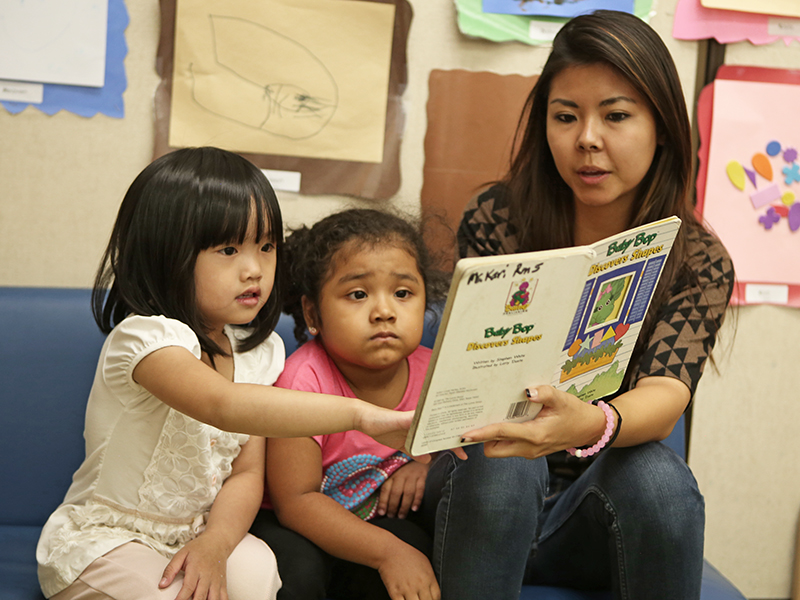
Preschool programs are playing a key role in helping children who speak languages other than English get ready for kindergarten. More than than one-half of students in those two programs – the largest ones statewide – speak a language other than English at home.
Vietnamese was ranked the third most common home language – backside Spanish and English – in the land preschool program in 2013-14 and is also the 3rd nearly mutual linguistic communication in K-12. Caput Get-go lists "East Asian languages" every bit the third nearly mutual abode language.
Many of those Vietnamese-speaking children attend preschools near Little Saigon, the largest enclave of Vietnamese people exterior of Vietnam, centered in Westminster and Garden Grove in Orange County.
The predominant linguistic communication in the Westminster School Commune's state preschool program is Vietnamese – spoken by 36 percent of students, followed past roughly a third who speak Spanish and a third who speak English. At Land School, where Nguyen teaches, more half of the preschoolers speak Vietnamese at home.

FERMIN LEAL/EDSOURCE TODAY
From left, Kevin Dang, Phillip Vo and Angie Nguyen work on their art projects during their preschool class at Land Schoolhouse in Westminster, Calif.
Throughout California'south preschools, a range of languages is spoken, sometimes with many dialects within those languages. Some programs, such as Caput Starting time, aim to employ at least i person who tin can speak each of those languages, fifty-fifty if just one child in the class speaks it – often a hard task.
Los Angeles Universal Preschool, which is funded by tobacco-tax money, has nearly 300 providers throughout the county. About 5 percent of the preschoolers speak languages other than English language or Castilian as a master linguistic communication, said Mariel Kyger, a research analyst for the program. About 9 percentage of preschool providers employ staff members who speak languages other than Spanish or English, including Korean, Armenian and Chinese.
"It seems similar an incommunicable task," said Keesha Woods, the segmentation director of the Los Angeles County Office of Education. "Our children's needs are changing from one year to the side by side."
Westminster school
The Westminster School District has long attracted a big Vietnamese population, with 21 percentage Vietnamese speakers among its English learners. Vietnamese immigrants began moving to the surface area after the fall of Saigon xl years ago and soon opened a string of businesses in the community, which became known as Little Saigon.
This school twelvemonth, the district started the get-go dual-language Vietnamese program in the state. It began with kindergarten and will expand to other grades in futurity years.
Westminster officials are talking virtually beginning the dual-language program in preschool, said Beverlee Mathenia, the commune's executive director of early education and expanded learning. Already, this year, the preschools are offering Pathways to Biliteracy awards, an Orange County program that gives certificates to children who master skills in two languages.
In a parent orientation session in early September, teachers stressed that the preschool classes aim to raise the children'due south start language while they master English language. With a mix of Vietnamese and Latino families, a instructor and an aide took turns leading the meeting in English, Spanish and Vietnamese.
"This is very, very important – that you support your child'southward start linguistic communication," said Tuy Truong, a teacher at Finley Simple Schoolhouse's preschool form. "We want to validate what you have at habitation."
Truong had to acquire English herself when she moved to the Little Saigon area from Vietnam at age 21, eventually earning her college degree. She was surprised when her college professor suggested that she get her instruction credential for Vietnamese.
"I thought, 'Am I ever going to teach Vietnamese?' I didn't know that nosotros could utilise information technology," Truong said.
Mathenia snatched her upwards as soon as she graduated near 10 years ago. "I wanted someone to speak Vietnamese and reverberate the culture," she said.
Classroom teaching

FERMIN LEAL/EDSOURCE TODAY
Gabriela Juarez stands next to her preschool instructor Lien Nguyen during a class presentation at Land School in Westminster, Calif.
Iii miles away in the Land Schoolhouse classroom, teacher Nguyen too uses her Vietnamese language skills to assist draw children out. The daughter of Vietnamese immigrants, Nguyen grew upwards in Los Angeles, simply her family spent their weekends in Picayune Saigon eating and shopping.
When the class started in early September, many of Nguyen'south students wouldn't say anything at all, she said. But Nguyen couldn't tell if the 3-year-olds couldn't speak the linguistic communication or they were interim shy because they were away from home. She used pictures to ask questions, like what they wanted for lunch or where they wanted to play.
Three weeks into schoolhouse on a Wednesday in September, the children were a chip more talkative. Nguyen showed the children how to draw faces on the board. "What color should my ears be?" Nguyen said in English, then repeating information technology in Vietnamese. "Short or long pilus?"
In the back, aide Carmen Vega sat with four Spanish-speaking students, giving them directions in their language.
When the children moved to different parts of the room with various activities, the teacher and aides held up a affiche with pictures – kitchen, blocks, books, play, fine art. They asked each kid, usually in English, where they wanted to go – a way to practice communicating.
"Say, 'My program is to go to the firm surface area,'" Vega told a more often than not Spanish-speaking girl. "What are you going to exercise at that place?"
"Make soup!" the girl said.
Later, Vega read a Spanish-linguistic communication book to two girls in the book surface area. One daughter practiced counting to 10 in Vietnamese by pointing to characters in the book. The next girl did the same in English. Then, Vega finished reading the book in Spanish.
Vega is learning a few words and phrases in Vietnamese – sit down, play, bathroom – to assistance the children. Sometimes, the Castilian-speaking children choice upwardly Vietnamese words and phrases.
Michelle Miller, the supervisor for the early education plan at Land Schoolhouse, said while the goal is to retain their native languages, children in the three-yr-former class are ofttimes fluent in English language after Christmas.
Vietnamese families
Educators in Westminster have seen immediate how cultural backgrounds influence parents' views on early education, differences also examined in inquiry.
A study in Early Childhood Inquiry Quarterly institute that parents' approaches varied among different Latino and Asian cultures. Academic performance among Vietnamese immigrant children was tied more closely to their parents' expectations, while for other Asian cultures information technology was related more to the families' income or parents' teaching levels.
Regardless, the written report plant that demographic factors, such equally income and parents' instruction, played a bigger function in students' academic success than use of a linguistic communication other than English at home.

FERMIN LEAL/EDSOURCE TODAY
Three preschool students at State School in Westminster spend part of a contempo forenoon reading language books. The diverse class has students from different backgrounds.
In Westminster, even though the district is virtually evenly divided by thirds among Spanish-, Vietnamese- and English-speaking families, Mathenia said she has more trouble recruiting Latino families, compared to Vietnamese families, for preschool. She recently hired more than Spanish-speaking staff members.
"We intentionally get out to recruit Castilian-speaking families," Mathenia said. "With Vietnamese families, they line up in droves."
Miller, who is Hispanic and speaks Spanish, said she finds that some Latino families are worried near sending their children out of the dwelling, so she explains in Castilian the importance of having children interact with others and learn before kindergarten.
But Vietnamese parents sometimes come in when the children are 14 months old, too early to enroll their children, Miller said.
Before starting preschool at Finley this schoolhouse year, 4-twelvemonth-old Tran Nguyen, who was born in Vietnam, taught herself how to count to xxx and say the colors in English language by using an iPad, said her mother, Chau Tran, in Vietnamese as the teacher translated. Because she doesn't speak English language, Tran sent her girl to a private tutor over the summer three times a week for an hour, spending $300 a month. Tran wanted a tutor to make up one's mind how well her daughter was learning English.
Afterward, the girl told her mother that she wanted to get to "a real school where other children are," Tran said. Tran saw a sign in three languages and signed her daughter up for Westminster's state preschool program.
Truong said tutoring is fairly common amidst some of her families, even low-income families who qualify for state preschool.
"As long as they can walk and talk, your kid is going to school," Truong said about the Vietnamese families.
To get more reports like this one, click here to sign upwards for EdSource'south no-cost daily e-mail on latest developments in education.
Source: https://edsource.org/2016/public-preschools-attempt-to-accommodate-diverse-languages-of-students/91899
0 Response to "Public preschools attempt to accommodate diverse languages of students"
Post a Comment